top of page
Archive of Publications and Poster Presentations

List of my publications and presentations

01
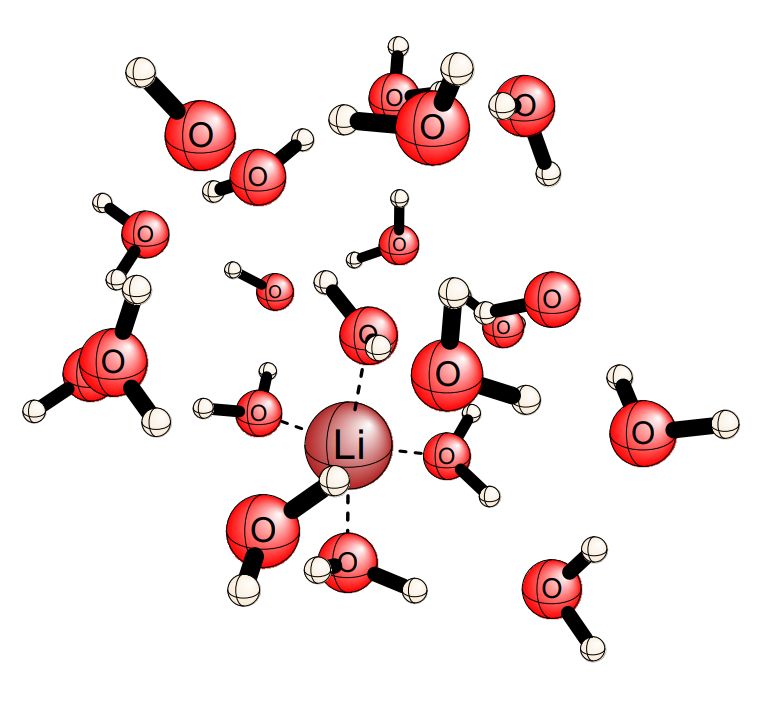
Exploring Cation–Water Interactions in Li(H₂O)ₙ⁺ (n=20-30) Clusters: A Computational Study of Structures and
Energetics
Energetics
Investigated Li(H₂O)ₙ⁺ clusters (n = 20–30) using ABC global optimization,
ωB97X-D/aug-cc-pVDZ
geometry
optimization,
and
DLPNO
MP2/CCSD/CCSD(T) single-point calculations extrapolated to the CBS limit.
Characterized coordination-number evolution, Li–O interactions, hydrogen-bond
networks, relative and binding energies, and binding free energies to establish benchmark-quality structural and energetic data for medium-sized lithium–water
clusters.

02
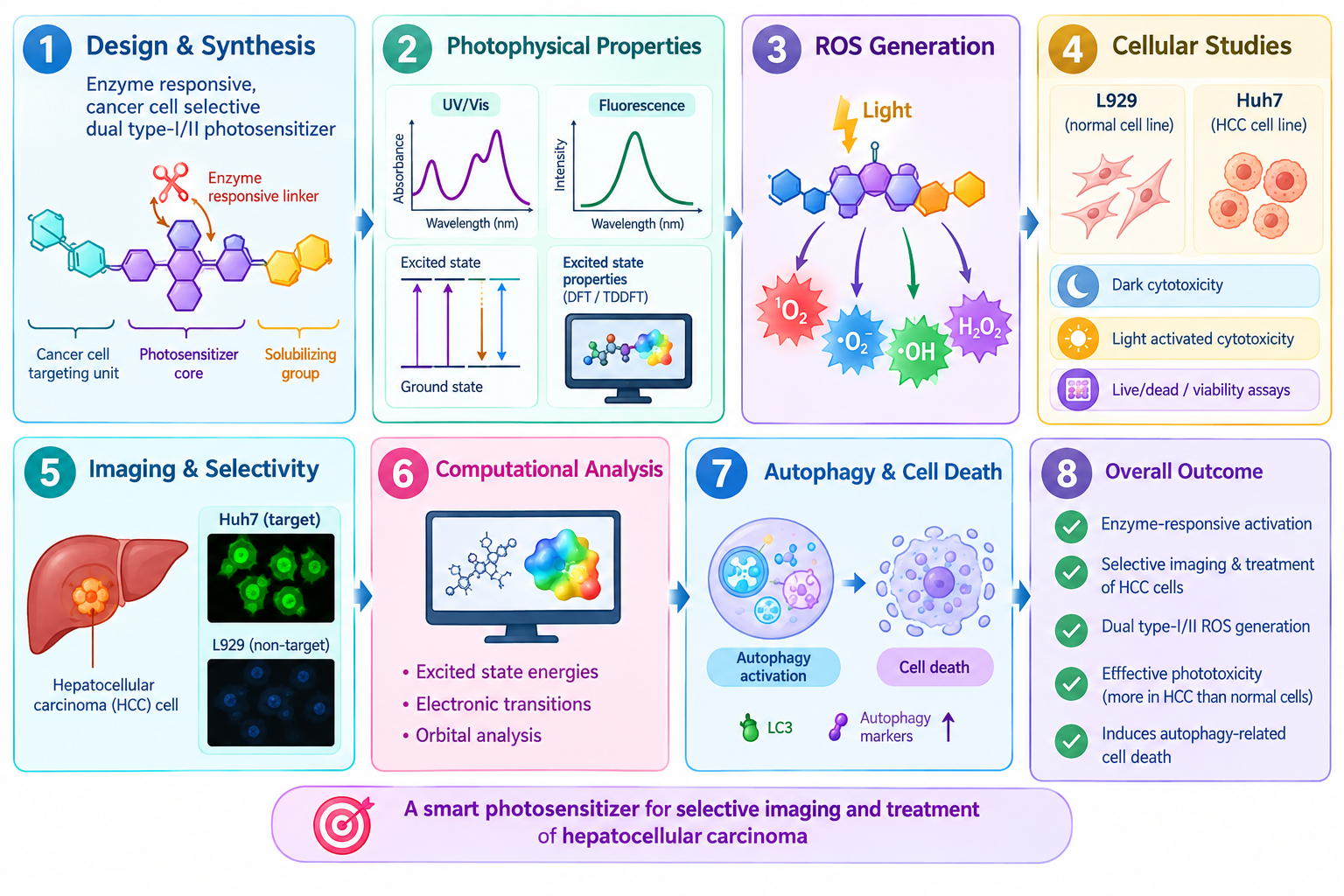
Development of an Enzyme
Responsive Dual Type-I/II Photodynamic Therapy
Agent
Responsive Dual Type-I/II Photodynamic Therapy
Agent
Developed an enzyme responsive cancer cell selective dual type-I/II photosensitizer for
the selective imaging and treatment of hepatocellular carcinoma cells. Evaluated its
photophysical properties, reactive oxygen species (ROS) generation capacity, dark and
light activated cytotoxicity in L929 and Huh7 cell lines, excited state properties using
DFT and TDDFT, and its relation with autophagic activity during cell death.

03
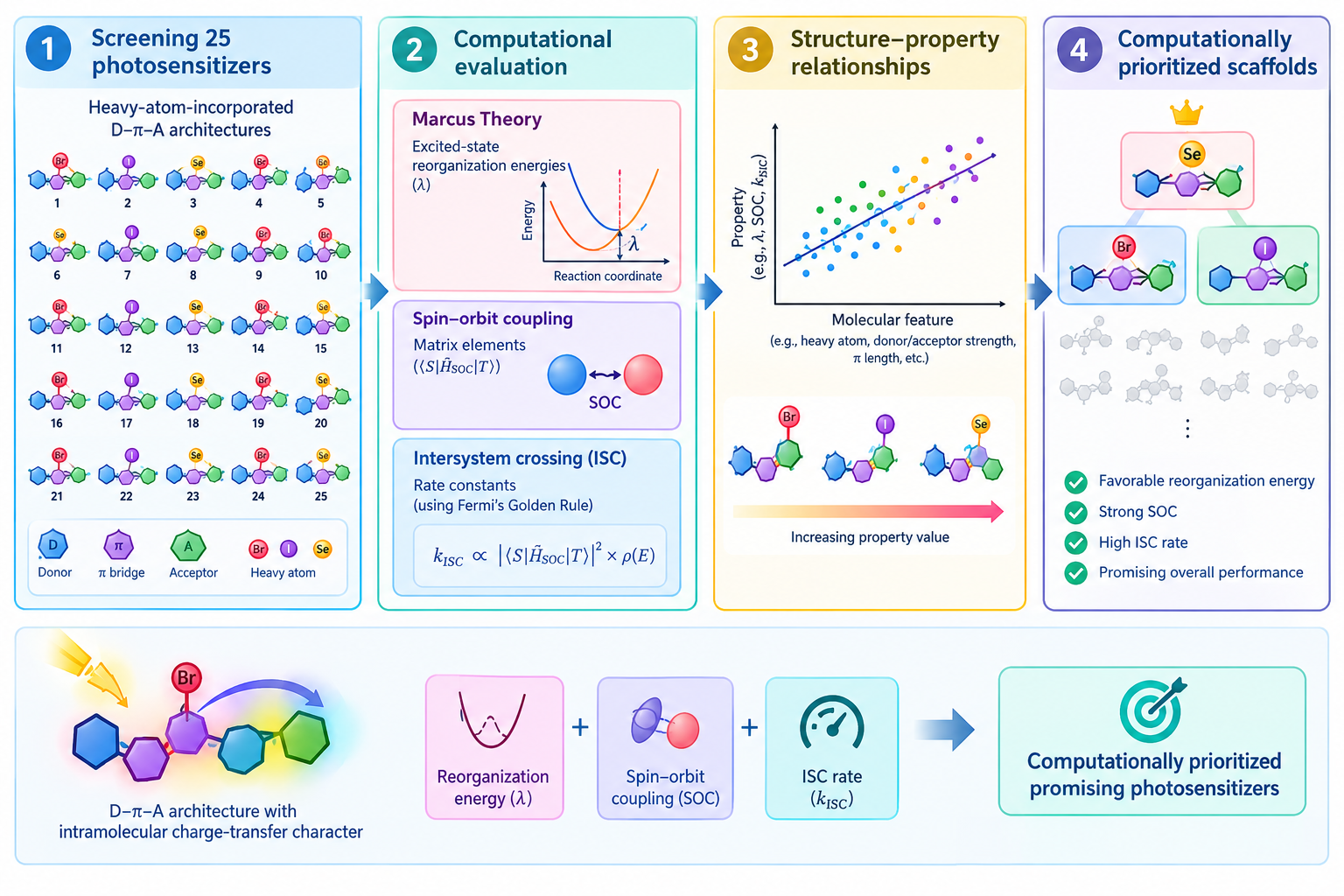
Benzoselenazole Hemicyanine Derivatives: A New Class of Highly
Efficient Photosensitizers for Photodynamic Therapy
Efficient Photosensitizers for Photodynamic Therapy
Systematically screened 25 heavy-atom-incorporated photosensitizers featuring D–π–A
architectures and pronounced intramolecular charge-transfer character. Calculated
excited-state reorganization energies according to the Marcus Theory, spin–orbit
coupling matrix elements, and intersystem crossing (ISC) rate constants using a Fermi’s
Golden Rule-based formalism. Established structure–property relationships and
computationally prioritized promising scaffolds.

04
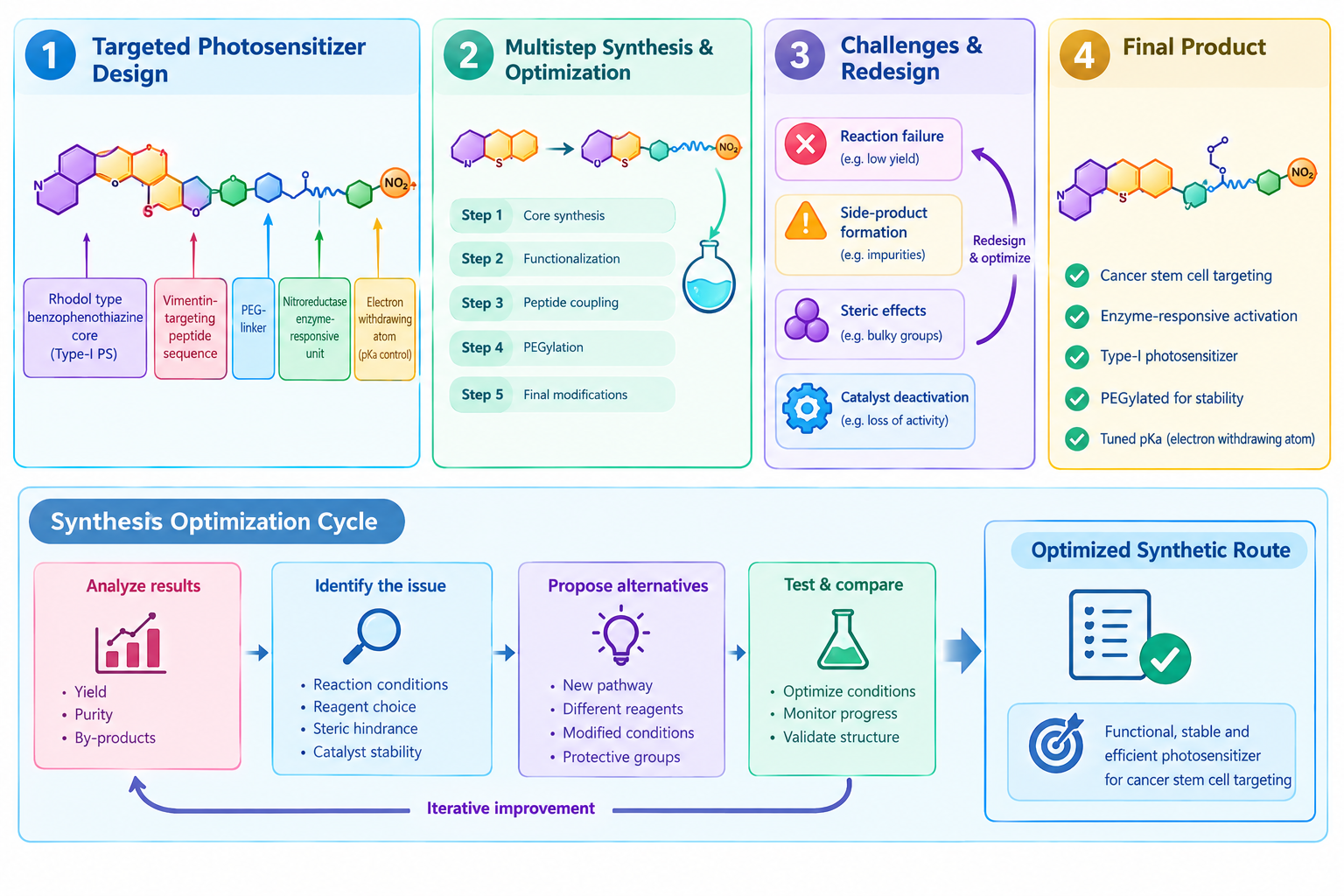
Synthesis of a Cancer Stem Cell Selective
Photosensitizer
Photosensitizer
Synthesized a cancer stem cell-targeted photosensitizer. A major component of my
work was multistep synthetic route development and optimization. I investigated
alternative synthetic pathways for the development of the first rhodol type
benzophenothiazine-based Type-I photosensitizer incorporating a nitroreductase
enzyme-responsive activation unit, vimentin-targeting peptide sequence, PEG-linker
and an electron withdrawing atom for pKa control. I systematically redesigned the
synthesis in response to reaction failure, side-product formation, steric effects, and
catalyst deactivation.

05
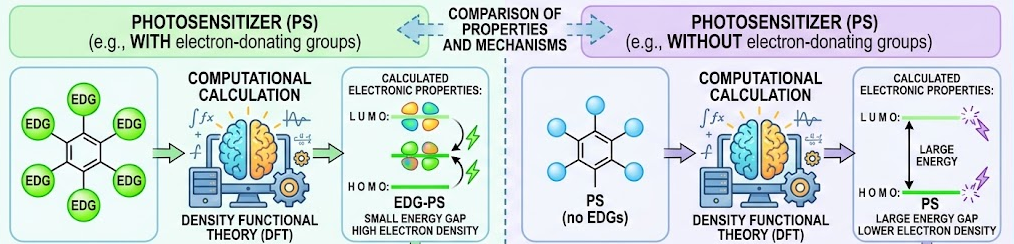
Donor-Engineered NIR-Emissive AIE Photosensitizers for Mitochondria-Targeted Phototheranostics
Provided computational support to elucidate the electronic properties underlying differences in ROS generation between photosensitizers with and without electron-donating groups.
bottom of page